Monthly: $0 today with a card, then $34 on day 4 unless you cancel before then. After the trial, 30 days' notice applies. Active on-campus students have academy access included. Check your existing student account before buying another subscription.
Chi Gong or Wu Ji Gong: which to take first
Start with The Living Breath: A Complete Guide to Chi Gong if you are new to this kind of practice. It is the broader course and assumes no experience. It teaches three foundational methods (Standing-On-Stake, relaxed and quiet practice, and optional spontaneous movement) with starting times and stop signs, and helps you set up a daily routine. Modules 6 and 7 are advanced and optional. It is listed under Taoist Philosophies.
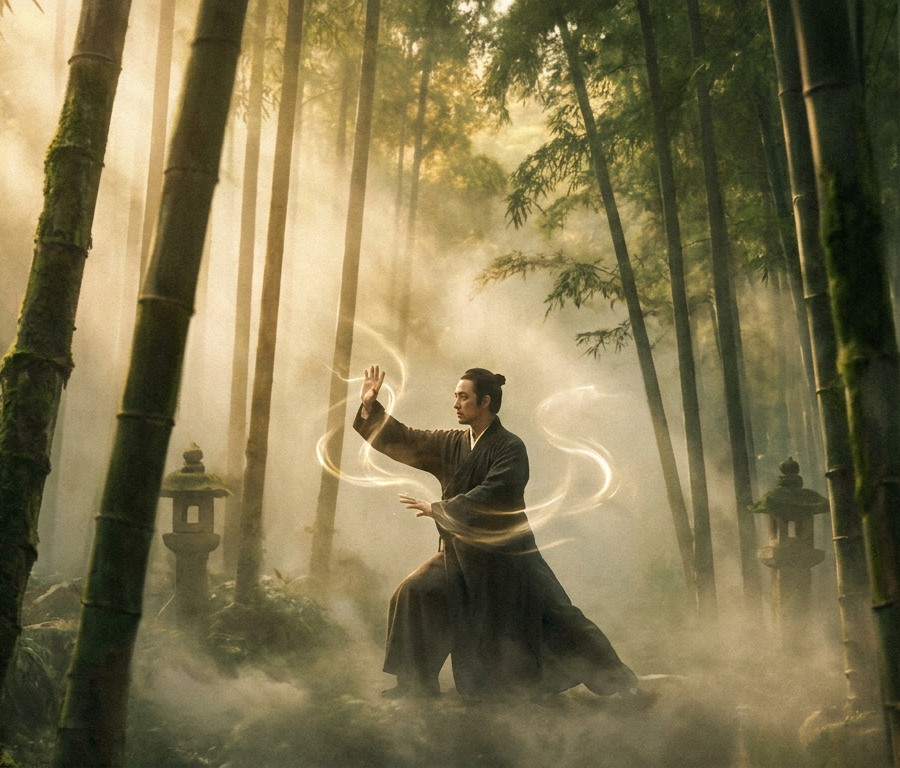
Wu Ji Gong: Primordial Tai Chi is narrower. Its 24 lessons are about one 12-minute movement form: the ideas behind it, its principles of practice and a 100-day practice plan. The lessons explain what each part of the form is meant to express and refer to an instructor's demonstration for the movements; they do not teach the sequence step by step. Take it after The Living Breath, or when you can learn the movements from an instructor. It is listed under Astral Magic and Mysticism.
Review the lesson outline and any lesson-specific preparation before you practise.
These studies do not provide clinical training or a professional qualification.
Full study requires active Academy access. This course can be audited independently of optional assessed programs.
About this course
Chi gong is one of the oldest health practices on earth. This course teaches the traditional practice of cultivating internal energy through breath, stillness, and simple movement, and it is clear about what the tradition claims and what research shows. Nine modules take you from zero experience to a sustainable daily practice grounded in classical Chinese medical theory.
Course outline
The foundation: the nature of chi, its role in Chinese medicine, and how chi gong differs from exercise.
Where chi lives, how it moves, and what happens when the flow gets disrupted.
1Meridians: The Body's Energy Highway5 min
2The Key Acupoints You Need to Know5 min
3The Dan Tian: Your Energy Center5 min
4The Small Circuit (Microcosmic Orbit)5 min
5The Large Circuit (Heavenly Cycle)5 min
6What Blocks Chi Flow (And What Opens It)5 min
What research does and does not show about qigong in chronic illness, cancer care, and immunity, and when not to practice.
1Chi Gong as Medicine: A Different Approach5 min
2Chronic Conditions and Chi Gong5 min
3Chi Gong and Cancer Recovery5 min
4The Immune System Connection5 min
5When Not to Practice: Contraindications and Safety5 min
Three foundational methods: Standing-On-Stake, Relaxed and Quiet, and Spontaneous Movement.
1Introduction to the Three Methods5 min
2Standing-On-Stake: First Posture (Months 1 to 3)5 min
3Standing-On-Stake: Second Posture (Months 4 to 6)5 min
4Standing-On-Stake: Third Posture (Months 7 to 9)5 min
5Relaxed and Quiet Chi Gong: Seated Method5 min
6Relaxed and Quiet Chi Gong: Standing Method5 min
7Relaxed and Quiet Chi Gong: Visualization and Breathing5 min
8Spontaneous Movement: Letting the Body Lead5 min
9Combining the Methods: Your First Practice Session5 min
The framework, schedule, and environment that make the difference between trying chi gong and living it.
1The 100-Day Rule5 min
2Best Times to Practice5 min
3Where to Practice: Environment Matters5 min
4Orientation and Alignment5 min
5Common Mistakes and How to Avoid Them5 min
6Building Your Personal Practice Schedule5 min
7Progress Markers: How to Know It Is Working5 min
Advanced and optional. The traditional progressions for developing external chi, and how to read claims about it.
1What Is External Chi?5 min
2How to Read an External-Qi Study5 min
3The Six Steps of External Chi Training5 min
4Developing Sensitivity to Chi5 min
5Working with a Practice Partner5 min
Advanced and optional. One-Finger Art, Magic Palm, martial applications, and Empty Force, as tradition and history.
1One-Finger Art: The Index Finger Method5 min
2One-Finger Art: Progressive Training5 min
3Magic Palm: Cultivating Laogong5 min
4Martial Applications of External Chi5 min
5Empty Force: History and Context5 min
The seven emotions, stages of meditation, and seven methods for entering the meditative state.
1The Seven Emotions and Your Health5 min
2What Stillness Offers5 min
3The Stages of Meditative Development5 min
4Seven Methods for Entering the Meditative State5 min
5The Unity of Person and Heaven5 min
6Patience, Confidence, and the Long View5 min
Where chi gong fits within Chinese medicine, martial arts, and internal cultivation.
1Chi Gong and Acupuncture: Shared Roots5 min
2Chi Gong and Herbal Medicine5 min
3Chi Gong and Tai Ji Quan5 min
4Chi Gong in the Martial Arts5 min
5Your Lifelong Practice: Where to Go from Here5 min
Related assessed programs
This course belongs to the following optional programs. Each has its own required course bundle, evidence review and separate fee. Each program page shows its approved fee and current registration status.